

Francois Xavier Tourte (1747-1835) is widely regarded as the creator of the most outstanding violin, viola, and cello bows of all time. Tourte is traditionally credited with establishing the weights, dimensions, and basic design for bows that remain the standard today.
Francois Xavier Tourte could neither read nor write. The only direct source of information about the development of his craftsmanship is the surviving bows themselves. Thus, a contemporary understanding of the chronology and influences on the evolution of modern string instrument bows relies heavily on conjecture and a rich anecdotal history.
Giovanni Battista Viotti (1755-1824) was a legendary violinist of Tourte’s time. Born in Sardinia, Viotti came to Paris in 1782, making a sensational debut that took the city by storm, and he would stay there for the next ten years. When Viotti arrived in Paris, Tourte was the city’s most esteemed bowmaker. Viotti soon became the most sought-after violinist in Europe. This raises the question: Did the two men ever meet and possibly collaborate on the design of the modern bow? Given their respective positions, it seems likely, although no primary source documentation of a relationship has been uncovered.
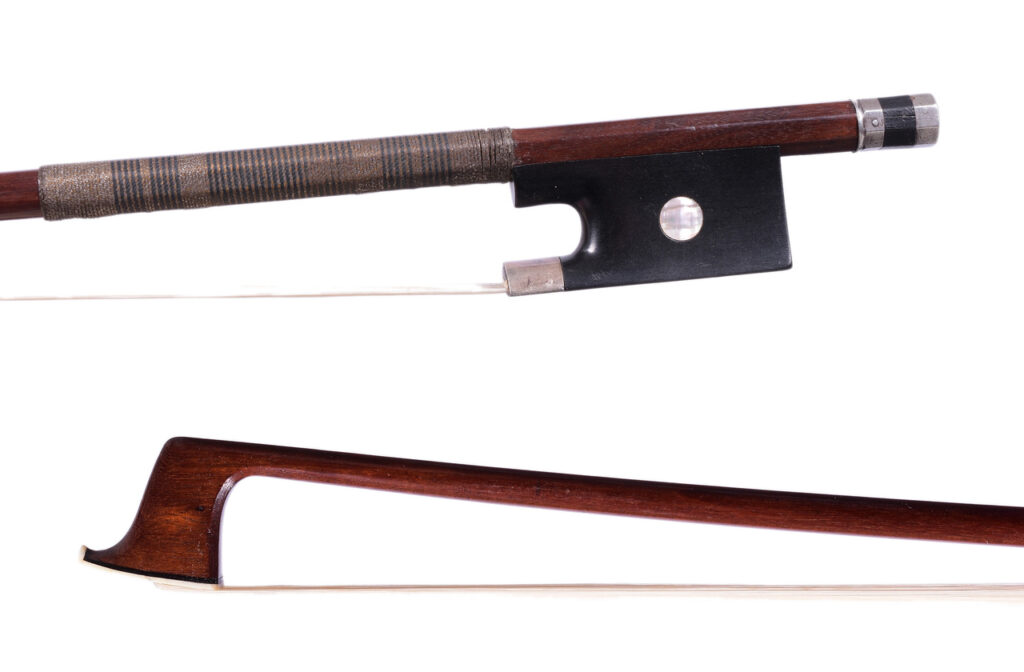
Francois Xavier Tourte violin bow
Collaborators?
The first author to assert a connection between Viotti and Tourte in the development of the bow was the Belgian musicologist François-Joseph Fétis (1784-1871). In his 1856 biography of Stradivari, Fétis included a section on Tourte, ascribing without citation a pivotal role to Viotti in the development of the modern bow. That Viotti’s residency in Paris coincided with at least part of the period in which Tourte developed the final form of his violin bow lends credence to Fétis’ assertion. However, other historical evidence raises questions about Viotti’s participation in the effort. The only references to a relationship between Viotti and Tourte that have ever come to light are from secondary sources. But regardless of whether Viotti provided any input to Tourte on the development of the bow, there is clear evidence that the bow Viotti actually used was a precursor to the final Tourte model.
Some six years after Viotti left Paris in 1792, composer and violinist Michel Woldemar (1750-1815) published an early description of a “Viotti” type bow in his Methode pour le Violon of 1798:
"Le No. 4: [this example] from the famous Viotti, differs little from that of Cramer’s head (named for violinist Wilhelm Cramer 1746-1799). Still, the head is lower and closer to the button and holds more hair, it is played [with the hair] a little relaxed and is today almost the only type in use."
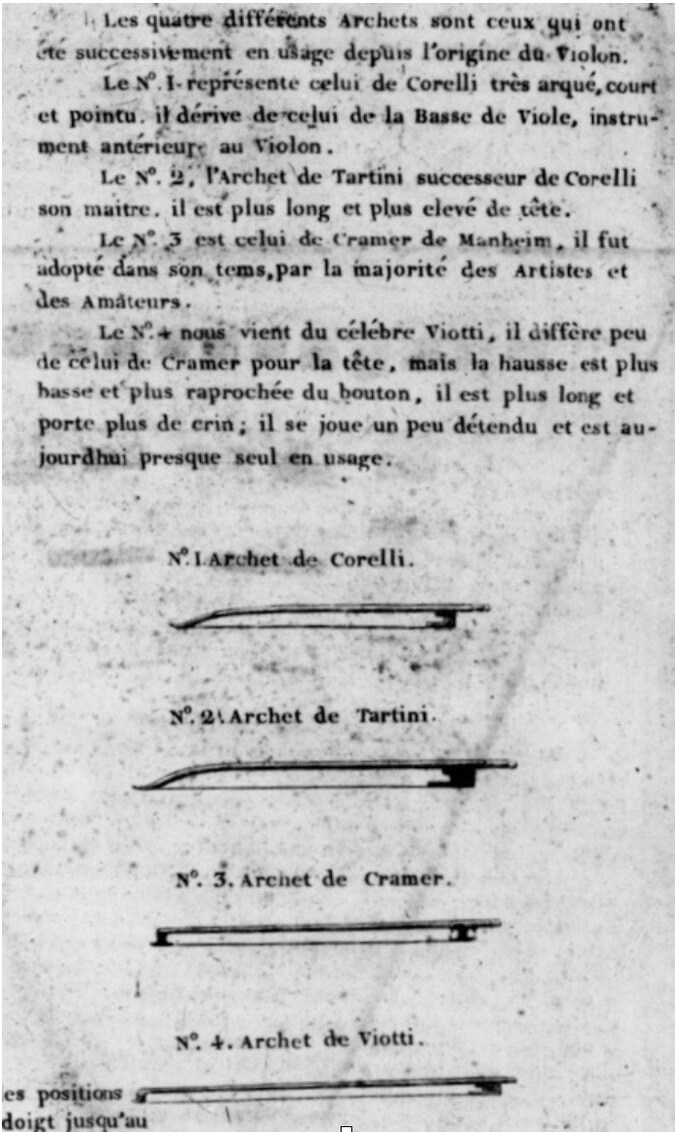
Methode Pour le Violon 1795
This depiction is not a first-hand account: As revolution swept France in 1792, Viotti fled Paris to avoid political persecution over his alliances with the French Court. Woldemar appears not to have arrived in Paris until 1804, long after Viotti’s hasty departure. Still, whatever the source, Woldemar’s depiction of the Viotti bow loosely corresponds to a more detailed description by the violinist and pedagogue Pierre Baillot (1771-1842).
L’Art du Violon
Baillot’s credentials as one of the leading violin pedagogues of his era and his well-documented relationship with Viotti make him an important source on the subject. In 1791, Viotti gave Baillot his first job in Paris, appointing him to the orchestra of the Theatre Feydeau. The two men remained on favorable terms after Baillot resigned from the orchestra some months later to pursue more lucrative opportunities. In 1795 Baillot was one of the founding professors of the Paris Conservatoire, arguably the first modern music conservatory. In 1835, toward the end of his long and illustrious teaching career, Baillot published his L’Art du Violon, in which he briefly described the evolution of the bow:
T"he Bow: As the variety of bow strokes has necessitated greater flexibility and a little more strength at the tip, the frog has been lowered, the tip raised, the stick lengthened a little. [Total length 70.38 cm] (figure 30)
Here is the form and size of the bow used by Viotti. [Total length 73.3-73.53 cm] (figure 31)
The bow generally used today has the same form as this one, but its total length is 74.1 cm. (figure 32)"
This last statement raises questions about Fétis’ assertion that Viotti was deeply involved with Tourte in developing the final version of the modern violin bow: by Baillot’s account, the so-called “Viotti” bow was only a precursor to the final model in use by most violinists by 1835.
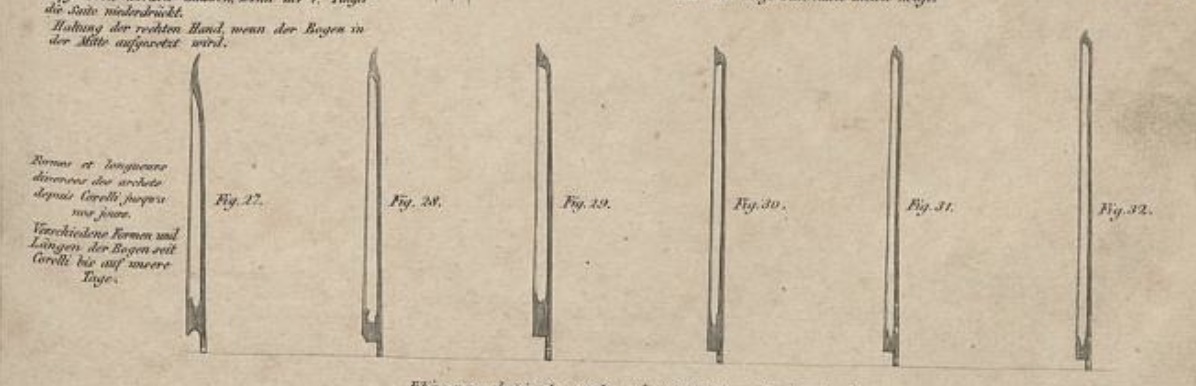
From Baillot's Art du Violone, 1835
Baillot’s illustrations correspond to surviving bows today: The example shown in “Fig 30” corresponds to a so-called “Cramer Head” bow. The example shown in “Fig 31” is of similar length and weight to a Cramer Head bow, but with a head design and lower head and frog heights that correspond to those found on a fully developed Tourte. The example illustrated in “Fig. 32” corresponds to a modern model.
In the seminal French bow-making book, L’Archet (2001), Bernard Millant and Jean-François Raffin provide detailed measurements of early F.X. Tourte sticks, ranging from 72 cm to 72.4 cm, and later Tourte sticks, measuring 72.5-73.2 cm. Millant and Raffin illustrate a “Cramer Head” bow showing the hand of F.X. Tourte with a length of 70.4cm, the same as the “Cramer Head” bow by F.X. Tourte illustrated below. The modern-style bow on the right, measuring 72.1 cm, was made c. 1810 by Jean Marie Persoit, who is presumed to have been trained in the atelier of Nicolas Leonard Tourte.
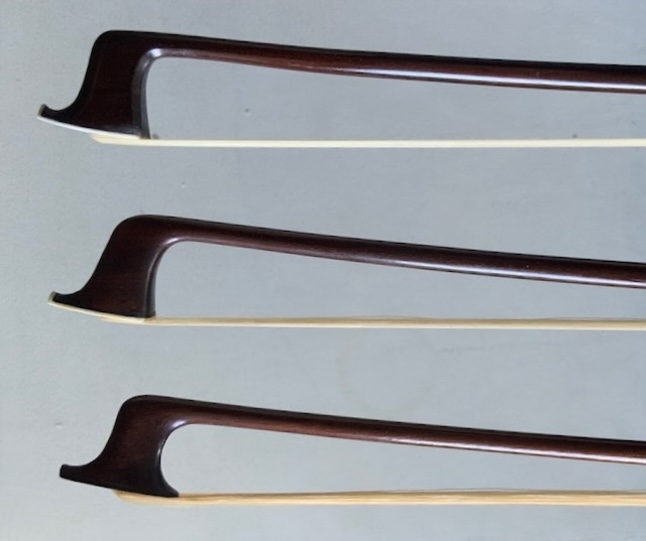
Cramer-Head-Viotti-model-J.M.-Persoit
Is the Tourte School bow in the middle of this photo the “Viotti” type illustrated by Baillot? In terms of appearance, age, design, and playing qualities, it corresponds to Baillot’s illustration and description. Measuring 70.8 cm in length, it is just 3 mm longer than a “Cramer Head” bow, but it has a modern style head and somewhat lower frog and is still considerably lighter and nearly 2 cm shorter than a fully developed Tourte.
Generations of experts have ascribed the final development of the modern bow to the early 1790s. Taking claims of Viotti’s participation at face value, it’s logical to conclude that the development of the modern bow would have pre-dated Viotti’s departure from Paris in 1792. But Baillot’s accounts of Viotti’s bow, which would have been based on experiences in 1791 and 1792 when the two men both lived in Paris, strongly suggest that the final development of the bow remained incomplete until some time after Viotti had left Paris.
A Bespoke Enterprise
The chronology of the final development of the modern bow is surely murkier than some historians would have us believe. Bow-making at the time of Tourte and Viotti may have been a more bespoke enterprise than is usually understood today. Competing models of bows were likely in use alongside one another according to the preference of individual musicians. More than once in the mid-1790s, Viotti was onstage for performances in London with Wilhelm Cramer, who is known to have favored the so-called “Cramer head” bow, quite different from Viotti’s. It seems likely that a range of bow models would have been in use by the orchestra members for those concerts. As standardization became the norm, the unequaled quality and ingenuity of the mature work of F.X. Tourte would become the model for the best bow makers to follow. Did Giovanni Battista Viotti have a direct influence on F.X. Tourte’s design? We may never know for sure.